
Last Updated November 8, 2026
The Florida Skunk Ape is a Bigfoot-like creature said to roam the Everglades, Big Cypress Swamp, and other wild corners of the state. Hundreds of sightings have been reported, most of them since the early 1970s, but no body, bones, or DNA has ever turned up.
Wildlife officials and skeptics chalk the reports up to black bears, hoaxes, and honest mistakes made in the dark.
Proof or no proof, the legend is alive and well. You’ll find the Skunk Ape on roadside signs, T-shirts, and bumper stickers, and there’s even a research headquarters dedicated to it out on the Tamiami Trail.
Here’s where the story came from, the sightings that made it famous, and why most scientists aren’t buying it – but residents of the Everglades know what they have seen and heard.

What Is the Florida Skunk Ape?
Witnesses describe an upright, two-legged creature somewhere between five and seven feet tall, covered in shaggy hair that ranges from reddish brown to nearly black. It’s usually pictured as a little smaller and leaner than the classic Pacific Northwest Bigfoot.
Then there’s the smell. Nearly every account mentions a powerful stench, compared to rotten eggs, wet dog, garbage, or skunk, and many witnesses say they smelled it before they saw anything. That odor gave the creature its best-known name.
Besides Skunk Ape, it has picked up a few other nicknames over the decades: Stink Ape, Swamp Cabbage Man, Myakka Ape, and simply Florida Bigfoot. North Florida even has its own local version, the Bardin Booger of Putnam County.
Where Did the Skunk Ape Legend Come From?
Ask around and you’ll often hear that the creature has haunted Florida for centuries. Some writers point to an 1818 newspaper story from the Apalachicola area about a man-sized monkey raiding food stores.
Others claim the Seminole and Miccosukee have long told stories about a hairy giant, sometimes given the name Esti Capcaki.
Those claims get shaky when you go looking for the originals. Skeptic Brian Dunning of the Skeptoid podcast searched old newspaper archives in 2023 and couldn’t find the early reports that show up in many cryptid books. He traced many of them to books by author Michael Newton, which don’t cite contemporary sources.
Dunning also found the supposed Seminole term only in cryptozoology writing, not in Seminole language sources.
What is documented is August 1971. That’s when the Associated Press ran a story about H.C. “Buzz” Osbon, an amateur archaeologist who said he and four friends were camping in Big Cypress Swamp when a creature appeared outside their tent around 3 a.m.
The next morning, they cast footprints that measured roughly 17½ inches long. Tellingly, Osbon said he hadn’t heard any Native legends about the creature, though he predicted some would turn up.
So the honest answer is this: Florida has always had its share of wild-man tall tales, but the Skunk Ape as we know it took shape in the early 1970s.

A Timeline of Famous Skunk Ape Sightings
- 1940s, Putnam County: Residents around the tiny community of Bardin begin telling stories about the Bardin Booger.
- 1942, Suwannee County: A driver reports that a hairy creature rushed out of the brush, grabbed his car, and pounded on it for about half a mile.
- 1963, near Gainesville: A family reports an ape-like creature prowling their rural home, including one night when it peered through a window.
- 1971–1975, Broward County: The biggest wave of sightings on record. Witnesses describe a 5- to 7-foot creature with dark red to black fur. Reports claim it entered homes and killed livestock, and one officer said he struck it with his car. Possees searched, but found nothing.
- 1970s, Palm Beach County: Two sheriff’s deputies say an ape-like creature stalked them through a grove. They fired at it and later found hair snagged on a barbed-wire fence.
- 1974, Dade County: Reports come in from suburban neighborhoods of a large, foul-smelling, hairy creature running upright.
- 1977, Tallahassee: A bill is introduced to make it illegal to harm or harass “anthropoids or humanoid animals.” It doesn’t pass.
- 1997, Ochopee: Fire chief Vince Doerr photographs a dark, upright figure crossing the road. Within two weeks, more than 50 people report sightings in Big Cypress National Preserve.
- 2000, Big Cypress: Dave Shealy, founder of the Skunk Ape Research Headquarters, releases video he says shows the creature moving across an open field.
- 2000, Sarasota County: The famous Myakka photos arrive at the sheriff’s office (more below).
- 2020–2021: The Florida Fish and Wildlife Conservation Commission (FWC) lists recent reports from Naples, Inverness, and Sewall’s Point.
The Myakka Photos: Florida’s Most Famous Evidence
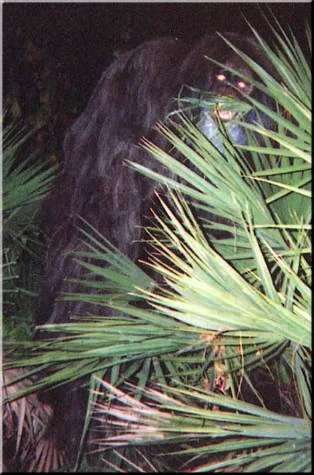
In December 2000, the Sarasota County Sheriff’s Office received an anonymous letter with two flash photographs. The writer, who described herself as an older woman living east of Sarasota near the Myakka River, said a large animal had come onto her back porch three nights in a row to take apples. Her husband thought it was an escaped orangutan.
She estimated it was 6½ to 7 feet tall even while kneeling, said it gave off an awful smell, and described deep “whoop” sounds. The photos show a dark, hairy, ape-like face peering out from behind palm fronds, its eyes glowing in the flash.
Cryptozoologists Loren Coleman and David Barkasy dug into the case and traced the film processing to a Sarasota photo lab, which confirmed the pictures were taken locally in the fall of 2000. Believers still call them the best photographic evidence of the Skunk Ape.
The problem is that the woman never came forward, and the creature in the photos doesn’t match any known ape.
Dunning points out three features: an unusual gray chin and chest pattern, thin straight lower fangs unlike any ape’s, and eyeshine, which great apes can’t produce because they lack the reflective layer behind the retina. It could be an animal, a custom costume, or a model. Photos alone can’t settle it.
Skunk Ape Sightings by the Numbers
- Hundreds of reports: The Bigfoot Field Researchers Organization (BFRO) has archived hundreds of Florida reports from almost every county, starting in 1955.
- 48 of 67 counties: Sightings have been reported in 48 of Florida’s 67 counties since 2010.
- The 1970s peak: Nearly every source agrees sightings spiked in the 1970s. Michael Newton’s often-repeated tally lists 166 reports for that decade, though he doesn’t give sources for the count.
- Confirmed specimens: Zero. No body, skeleton, tooth, or verified DNA sample has ever been found.
One of the best articles on the Florida Skunk Ape was produced by The Smithzonian Magazine in 2014, The article claims multiple pieces of evidence including footprints, video and photographic evidence.
The Doubts: Why Scientists Remain Skeptical
For all the stories, the case for the Skunk Ape runs into some big problems.
No physical evidence
A breeding population of large primates would leave behind roadkill, bones, hunting encounters, and trail-camera footage. Florida has some of the most heavily traveled wildlands in the country, and nothing definitive has ever turned up. There’s also no fossil evidence that non-human primates ever lived in Florida.
Wildlife officials say no
An FWC spokesperson told News 6 in Orlando that there’s no direct evidence the creature exists, and suggested many sightings could be wild hogs or bears. Back in 1998, the National Park Service told the BBC it considered the Skunk Ape a hoax.
The black bear explanation
Skeptical investigator Joe Nickell has suggested that many reports may be Florida black bears, possibly ones with mange. A bear standing on its hind legs, patchy and strange-looking in poor light, could easily pass for something stranger.
Hoaxes and costumes
Smithsonian writer Joseph Stromberg visited Shealy in 2014 and said it was hard to see anything in the 2000 video but a man in a gorilla suit. The legend also has commercial value. Skeptics note that the creature’s most active promoter runs a roadside attraction built around it.
Night, swamps, and expectations
Most sightings happen at night or in dense swamps, often from a distance. Add the region’s natural swamp odors and a well-known local legend, and it’s easy for an ordinary animal to become a monster.
Visiting Florida’s Skunk Ape Country
Believer or not, chasing the legend makes a great road trip.
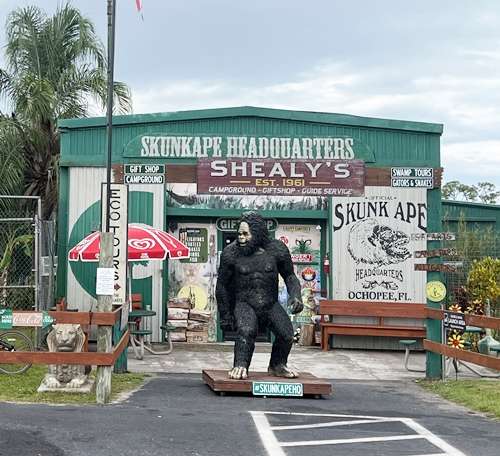
- Skunk Ape Research Headquarters: Located at 40904 Tamiami Trail East in Ochopee, this gift shop and mini-museum displays footprint casts, photos, and news clippings, with a campground on the property. It’s run by Dave Shealy, who says he saw his first Skunk Ape at age 10 in 1974. Check current hours and admission before you go.
- Nearby stops on US 41: The Ochopee Post Office, often called the smallest in the country, and Clyde Butcher’s gallery are both along the same stretch of road. Take a trip along the Tamiami Trail.
- Big Cypress National Preserve: Ground zero for Skunk Ape sightings, with boardwalks, scenic drives, and some of the best wildlife viewing in Florida. The Big Cypress Swamp and Alligator Alley go hand in hand.
- Myakka River State Park: The area tied to the famous Myakka photos, with canopy walks, airboat tours, and plenty of alligators. See Myakka River State Park nature .photos
Heading across the state? Our guide to Tamiami Trail vs. Alligator Alley – Florida Road Trip Choice covers the drive through the heart of Skunk Ape country.
So, Is the Florida Skunk Ape Real?

The evidence says probably not. The documented legend only goes back to 1971, the best photos come from an anonymous source, and decades of searching haven’t produced a single bone.
But the Skunk Ape has become something real in another way: a piece of Florida culture, as much a part of the Everglades experience as airboats and gator spotting. Go see for yourself, and if you smell something awful out on the Tamiami Trail, well, you never know.
Frequently Asked Questions About Florida’s Skunk Ape
Is the Florida Skunk Ape real?
There’s no scientific evidence the Skunk Ape exists. Despite hundreds of reported sightings, no body, bones, or DNA has ever been found, and wildlife officials attribute most reports to bears, wild hogs, hoaxes, or misidentification.
Where is the Skunk Ape most often seen?
Most sightings come from the Everglades and Big Cypress Swamp in Southwest Florida, but reports have come from nearly every county in the state, including Myakka River State Park and North Florida’s Putnam County.
Why is it called the Skunk Ape?
The name comes from its smell. Witnesses almost always describe a terrible stench, often compared to a skunk, rotten eggs, or garbage.
Where is the Skunk Ape Research Headquarters?
The Skunk Ape Research Headquarters is at 40904 Tamiami Trail East in Ochopee, Florida, on US 41 near Big Cypress National Preserve.
What are the Myakka Skunk Ape photos?
They’re two flash photos mailed anonymously to the Sarasota County Sheriff’s Office in December 2000, showing an ape-like creature in a backyard near the Myakka River. Their origin has never been confirmed.

Author’s Bio Larry Edger – entrepreneur, business owner, consultant and primary author of Florida Travel Blog. Mr. Edger successfully developed restaurant concepts after retiring from the title insurance business. With a passion for travel and love of Florida, he began documenting fascinating destinations in what is now called Florida Travel Blog. Now, Florida Travel Blog is one of the top go-to sites for Florida travel information.

Never forget anything – again! Get your free vacation packing list.

Where Is Chattahoochee Florida? A Complete Local Guide
Last Updated September 9, 2026 Chattahoochee, Florida sits in the far northwestern corner of the state, in Gadsden County, just a few miles south of the

What are the Best Beach Destinations in Florida for Families?
We have been traveling Florida for over 40 years. Here are our 24 best beach destinations in Florida. From the far reaches of the Panhandle

Best Beaches on Florida’s West Coast: 21 Gulf Coast Picks (2026)
We’ve visited every beach on this list. Here are the 21 best beaches on Florida’s west coast — from Clearwater south to Marco Island — with parking, tips, and what makes each one worth the trip.

Marco Island, Florida: The Complete Travel Guide
They call it the “Hawaii of the East,” and once you arrive, the nickname makes perfect sense. Marco Island sits at the southern tip of

Key Largo to Key West Florida Mile By Mile Guide
Key Takeaways Top 10 Stops – Key Largo to Key West John Pennekamp State Park Florida Keys Wild Bird Center Theater of the Sea ROBBIE’S

Best Places in Florida for Young Adults to Vacation (2026 Guide)
Florida isn’t just theme parks and family trips—it’s beaches with a pulse, neighborhoods with art and music until late, and water adventures you can’t get

Clearwater Beach Visitors Guide – Unwind in Paradise
Last Updated April 18, 2026 Clearwater Beach delivers powder-soft sand, calm Gulf water, a walkable marina-to-pier strip, and nightly sunset vibes. As Tampa Bay locals,

Interesting Facts About the Florida Everglades – 100 Of Them!
Our Number One Fact About The Everglades — “The Florida Everglades is one of the most extraordinary ecosystems on Earth! An immense subtropical wetland famous

Guide To Florida Keys: Resident’s Essential Tips
You are about to embark on a journey through the most beautiful tropical islands in the world. This guide to the Florida Keys is a


